Legal
Financial Services Industry Strives to Navigate U.S. Latino 'Bothism'
Marketers often fall into the trap of binary thinking, hindering creativity and clashing with consumers seeking fluidity. While the industry has struggled to embrace bothism – the concept of merging seemingly opposing approaches for better results – multicultural consumers in the U.S., particularly bi-cultural Latinos, have fully adopted it. Many see themselves as American and Latino, not half and half, but 200%, wholly embracing their American and Latino identities.
Honing in on the financial services sector, let’s explore cultural bothism among bi-cultural Latinos through the lens of language, age, and income to gain insights that can inform financial institutions' strategies to engage this diverse consumer group effectively.
Language: Spanish vs. English
When discussing how to reach Latinos, language tends to be the most polarizing topic. Traditional Spanish-language media portrays all Latinos as Spanish speakers, while newer media platforms targeting younger Latinos suggest otherwise. However, recent Pew Research data reveals a nuanced reality: 75% of all Latinos can proficiently converse in Spanish. Yet, this percentage varies significantly across generational cohorts, with second-generation Latinos at 69% and third-generation Latinos at 34%. Considering the youthfulness of the Latino population, with 25.7% of U.S. children being of Hispanic origin, 32% of Hispanics being under 18 and 26% being Millennials, it's evident that targeting specific generational segments is crucial. For financial products, the language strategy should be tailored accordingly:
For immigrants, Spanish remains a safe bet. For Gen Alpha and younger Millennials, English is preferable. For older Millennials and Gen X, Spanglish can be effective when used authentically, as research indicates its power.
Age: Older vs. Younger Latinos
Marketers often highlight the youthfulness of the Latino population, with the median age at 30 compared to 41.1 for non-Hispanics. However, this demographic is also rapidly aging, with the number of Hispanic adults aged 65 and older nearly tripling since 2000 and projected to quadruple by 2060. This dual demographic reality presents unique challenges and opportunities, especially in financial services.
Caregiving in particular is a significant concern, as Latino caregivers face financial strain while balancing work and caregiving responsibilities for both children and elderly family members. Financial institutions can address these needs through resources like multigenerational retirement planning workshops, multilingual financial education materials, customized financial products, the promotion of government assistance programs, and the provision of culturally sensitive advisors.
Income: High income vs. Low Income Latinos
In addition to language and age, income must be considered. Hispanic households had a median net worth of $52,190 in 2020, significantly lower than the $195,600 median for non-Hispanic households. Despite economic challenges, many Latinos still view the U.S. as offering more opportunities and better healthcare access than their countries of origin. Our research, the Millennial project, found that over 71% of Millennial Latinos believe in the American dream, compared to 55% of non-Latino Millennials.
Homeownership represents a cornerstone of the American dream for many Latinos. In 2023, the Hispanic homeownership rate reached 49.5%, with a net gain of 377,000 owner-households. While facing barriers like rising interest rates and low inventory, Latino homebuyers remain resilient, utilizing co-borrowers and specialized programs to achieve homeownership.
Financial institutions can assist Hispanic homebuyer hopefuls through accessible homeownership programs, community outreach and education, multigenerational financial planning, cultural competency training for staff and accessible financial resources.
Navigating Latino bothism in financial services goes beyond the scope of these three examples, yet they serve as a framework for fostering genuine connections with Latinos. Marketers within the financial sector must transcend binary thinking and embrace the nuanced duality within this diverse consumer base, understanding how factors like language, age, and income shape their perspectives. By doing so, financial institutions can effectively tailor their strategies to meet Latino consumers’ needs and build meaningful relationships that drive long-term success.
This blog post was originally published on MediaPost.
we demistify diverse communities through research technology
Legal
Authenticity Matters: Why Market Research Needs Diversity to Connect with Black Consumers
Black Americans, comprising about 14% of the U.S. population, wield significant economic influence, with buying power surpassing $1.5 trillion. Their cultural impact is equally undeniable, shaping everything from music and fashion to cuisine and beyond. Yet, generally, brands fail to invest in the market research needed to truly understand the complexity of this demographic.
Like most multicultural consumers, Black Americans are not a monolith. Within this group are subcultures that extend far beyond skin tones and hair textures to differences in culture, countries of origin, geography and language.
Beyond demographics are psychographics, right? Traumatic events like George Floyd's death deeply affected many Black consumers, prompting shifts in their brand interactions. Despite these challenges, there's a growing interest among brands in understanding and serving Black consumers, particularly Gen Z. Authenticity emerges as a crucial factor, with Black consumers seeking brands that acknowledge them, invest in their communities and empower them.
However, the lack of diversity within the market research industry remains a glaring issue, jeopardizing efforts to engage this consumer group. The failure to build diverse and inclusive teams hinders authentic insights and decision-making processes, leading to tone-deaf marketing campaigns and underwhelming customer experiences. Brands that genuinely understand what Black consumers like and build real connections with them will discover a vast, hidden market just waiting to be explored.
In this episode of The New Mainstream podcast, Dawn V. Carr, CEO and Founder of Mahogany Insights, discusses the importance of increasing diversity within the insights industry and how it can lead to more meaningful connections with Black consumers.
we demistify diverse communities through research technology
Legal
The Importance of Hispanic Market Research: Hispanic Voices Matter
The Hispanic market is no longer a niche—it's a cultural and economic powerhouse. Forget the outdated stereotypes—today's Hispanic consumers are a diverse and influential group shaping trends and driving economic growth. Projected to reach a staggering 132 million individuals by 2050, Hispanics will be the nation’s largest demographic, wielding immense buying power that already surpasses 25% of dollars spent in the U.S.
To build authentic connections with this demographic, brands must prioritize Hispanic market research, exploring consumer attitudes, behaviors and preferences and unlocking valuable insights. However, traditional research methods often fall short, lacking familiarity with this community's diverse cultures, languages and experiences. A deep understanding of cultural values, consumption habits, and the strong family dynamics that shape Hispanic consumer behavior is crucial.
This is where online panels come in. These online communities consist of pre-recruited Hispanic consumers willing to participate in online surveys and focus groups. By leveraging online panels, brands gain access to a broader pool of Hispanic consumers, including those who may be difficult to reach through traditional methods like in-person surveys or geographically limited focus groups. This allows you to gather more nuanced and representative data, leading to a deeper understanding of each segment's unique needs, preferences and cultural influences.
Online panels present several advantages for collecting data from Hispanic consumers. Here are a few key reasons why they are especially effective:
- Mobile-First Approach: Nearly 80% of U.S. Hispanic adults access the internet via their mobile devices. Online panels are optimized for mobile participation, making them convenient and accessible for this tech-savvy demographic.
- Geographic Diversity: Online panels transcend geographic limitations, allowing you to reach Hispanic consumers across the country, including those in rural areas or with limited access to traditional research methods.
- Targeted Recruitment: Reputable online panels offer diverse participant pools segmented by various demographics, including country of origin, generation, income level, and geographic location. This allows you to target specific segments of the Hispanic market for a more focused and insightful study.
- Increased Response Rates: Online surveys within panels often boast higher completion rates than traditional methods, leading to a richer data set and more reliable insights.
By considering these factors and adopting a "mobile-first" approach in your panel design, you can ensure a representative sample that accurately reflects the diverse Hispanic market. Doing so empowers brands to develop targeted marketing strategies that resonate effectively with this influential consumer group.
Choosing the Right Partner
Including Hispanic voices in your research through online panels contributes to a more representative study, which mitigates the risk of costly marketing missteps.
ThinkNow is the preferred source for double opt-in Hispanic sample in the United States and Latin American countries, maintaining an online panel of over 1 million Hispanic panelists representing a diverse range of backgrounds, lifestyles and perspectives.
To learn more, reach out to us.
we demistify diverse communities through research technology
Legal
Revealed: The Critical Role of Brand Strategy in Business Success
Whether refreshing an existing brand or launching a new one, the fundamentals remain the same— understanding the "why" behind your brand is critical to its long-term success. While logos and color palettes are often seen as the face of a brand, they are merely identifiers, visual representations of a brand’s ideals. But branding goes deeper than that.
Branding is the culmination of all the experiences, values, and perceptions that define a brand. It's the emotional connection customers feel, the stories they tell about you, and the reasons they choose you over competitors. It's essentially your reputation – what people say about you when you're not around.
But building a strong brand isn't just about how you present yourself to the world. It’s also vital to cultivating internal alignment. Engaging your employees, understanding their needs, and empowering them to live the brand's values are essential to brand sustainability. When employees believe in and embody the brand ethos, they serve as ambassadors of it in the marketplace.
Beyond the customer relationship is the synergy between brand strategy and business strategy. A well-defined brand strategy clarifies your market position, informs your marketing efforts, and shapes a cohesive customer experience at every touchpoint.
In this episode of The New Mainstream podcast, Darren Horwitz, Founder of TenTen Group, delves into branding basics and the role brand strategy plays in achieving business success.
we demistify diverse communities through research technology
Legal
The Pulse of American Voters: Insights from the 2024 Presidential Election Survey
Americans are gearing up to make their voices heard as the 2024 Presidential Election approaches. With only six months before ballots are cast, emotions are running high as the nation prepares for one of the most consequential elections in history. ThinkNow tapped into the pulse of likely voters with a nationwide online quantitative survey, uncovering the attitudes and trends shaping this pivotal moment in American democracy.
Download the report here.
A Diverse and Engaged Electorate
The survey, which reached 2,000 Americans and 1,443 likely voters, highlighted a significant level of engagement among various demographic groups. While approximately 80% of Non-Hispanic Whites, Asians, and African Americans expressed their intention to vote, around 70% of Hispanics indicated the same. Despite historical patterns suggesting a potential gap between reported intentions and actual turnout, the demographic differences align closely with past trends.
Not everyone, however, is interested in voting. Among the top explanations cited was the lack of appealing candidates, with Gen Zers exhibiting the lowest interest in politics overall. Furthermore, Baby Boomers and Non-Hispanic Whites were most likely to express dissatisfaction with the current slate of candidates.
Seven States Poised to Determine Election Outcome
One of the survey's most notable findings was the even split among likely voters between Republican and Democratic candidates. In pivotal swing states such as Arizona, Georgia, North Carolina, and Michigan, Republican candidates held a clear edge, potentially tipping the scales in favor of the GOP. If actual voting results were to match current survey results, the Republican party would obtain the 270 electoral votes needed to win the White House.
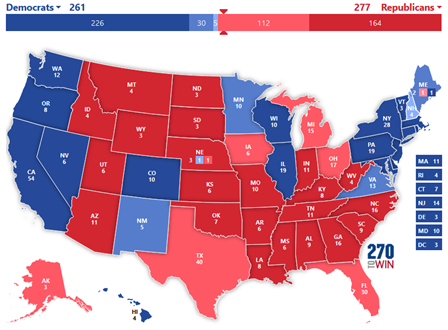
Interestingly, if Michigan, with its 15 electoral votes, were to vote for the Democrats, they would retain the White House.
TV News Still Rules
When it comes to sourcing information about candidates, traditional media outlets such as TV news and news websites remain the primary channels for likely voters. However, social media and conversations with family and friends also play a significant role, particularly among younger demographics and certain ethnic groups.
Interestingly, the choice of information sources varied across swing states, reflecting each region's diverse media landscapes and campaigning strategies.
The Economy Takes Center Stage
Amidst a myriad of issues, the economy emerged as the foremost concern for likely voters nationwide. Healthcare, social security, and immigration also ranked prominently among voters' priorities, highlighting the multifaceted nature of electoral decision-making. Notably, Republican and Democratic voters exhibited divergent priorities, with the economy, immigration, and a strong military resonating strongly among the former, while healthcare and gun laws were top issues for the latter.
Furthermore, generational disparities on issues were evident, with Millennials prioritizing anti-poverty initiatives and LGBTQ+ rights. Gen Xers and Boomers, on the other hand, focused more on traditional concerns like abortion and national security. Gen Z cares more about student loan repayment than other groups by a wide margin. In swing states, variations in issue salience were observed, reflecting each region's unique socio-political landscapes and demographic compositions and the need to target messaging at the local level.
Challenges to Electoral Confidence
Despite the impending electoral showdown, concerns lingered regarding the fairness and integrity of the electoral process. Alarmingly, less than half of likely voters expressed confidence in the upcoming elections' fairness, with Republican voters exhibiting the highest levels of skepticism. Surprisingly, a substantial proportion of Hispanics voiced doubts about the election's fairness, underscoring the need for enhanced efforts to bolster confidence and transparency in the electoral system.
In Conclusion
As the 2024 Presidential Election approaches, the insights gleaned from ThinkNow's survey offer a snapshot of the diverse perspectives and priorities shaping the American electorate as they currently exist. Public opinion will certainly shift in the coming months, but these findings can provide valuable guidance for candidates, policymakers, and stakeholders navigating the intricacies of current American electorate. Ultimately, democracy is founded on the principles of participation and representation. With an evenly divided electorate, the outcome of the coming election will be determined by the enthusiasm each party can generate.
Download the report here.
we demistify diverse communities through research technology
Legal
Is Market Research Poised for Sustainable Growth in the AI Era?
Effective market research goes beyond understanding trends to identifying opportunities in the market. But many companies struggle to translate data insights into tangible financial gains. This struggle stems from a tendency to diminish the significance of market research instead of acknowledging its profound potential as a revenue generator. Failing to see the strategic value of research hurts the bottom line and creates distance between the consumer and the brand. Companies need a deep understanding of consumers, and market research is the most effective way to achieve that.
How market research does that is changing, however. Artificial Intelligence is transforming the market research industry. New AI-powered methodologies, like synthetic panels, are creating opportunities for marketers to achieve similar results in less time with fewer budget constraints.
But AI isn't a silver bullet. Though rapidly evolving, the technology is new, and the accuracy of these models is still questionable. These new tools should be seen as complements, not replacements, for proven research methodologies.
One thing is certain – the future of market research lies in effectively integrating data, insights, and human curiosity. By leveraging these elements, researchers can become strategic partners, driving real-world business results and ensuring market research is a true value-add, not just a cost.
In this episode of The New Mainstream podcast, Michael Nevski, Director of Global Insights at Visa, delves into the vital link between market research and revenue growth and explores the potential of AI to reshape the industry.
we demistify diverse communities through research technology
Legal
Reaching the Right Voters: Using Online Sample for Smarter Political Campaigns
With the 2024 presidential election looming, political campaigns and voters are gearing up for what could be the most highly anticipated showdown in recent memory. While there are few certainties at this point, one factor has become abundantly clear. In this highly competitive climate, voter data collection is undergoing a dramatic transformation as political campaigns employ increasingly sophisticated methods to understand the electorate.
Traditional methods, heavily reliant on phone calls and in-person surveys, are giving way to a new era of online sample collection that makes political market research faster, more cost-effective, and ultimately, more insightful.
The Limitations of Traditional Methods
For decades, political campaigns relied on phone surveys and doorstep polling to understand voter sentiment. While these methods can provide valuable data, they come with inherent limitations. Phone surveys struggle with low response rates. Increasing spam calls and robocalls makes people wary of unknown numbers, and some demographics, like younger voters, just aren’t interested.
In-person surveys, while offering a higher response rate and access to hard-to-reach audiences, are expensive and time-consuming. Achieving a statistically significant sample size across a large geographical area can be a logistical nightmare for campaigns with limited resources.
The Benefits of Online Samples
The 2020 pandemic accelerated consumers’ shift to digital, from e-commerce to streaming. The same can be said for political campaigns. By turning to online sample collection, political campaigns can partner with online survey platforms with access to vast pools of pre-recruited participants, streamlining data collection and potentially reaching demographics less accessible through traditional methods.
These platforms leverage a variety of methods to build their samples, including:
- Online Recruitment: Individuals can sign up to become panelists and receive invitations to participate in surveys on various topics, including politics, often in exchange for incentives like points or rewards.
- Social Media: Platforms can leverage targeted advertising on social media to recruit participants who meet specific demographic criteria.
- Website Intercepts: Visitors to a campaign website can be invited to participate in a short survey before leaving the site.
The abundance of and accessibility to consumer data have made online sample popular among political campaigns, and its advantages have proven beneficial for candidates. During the 2018 U.S. midterm election, the Alexandria Ocasio-Cortez campaign (AOC) leveraged online surveys to identify key issues for voters in her district and tailor her messaging accordingly. The campaign's data-driven approach is credited with helping AOC achieve a surprise victory over a well-funded incumbent.
More specifically, the advantages of online sample include:
- Larger, more diverse samples: Online platforms offer access to millions of potential participants, allowing campaigns to gather data from a broader range of demographics and geographic locations. This ensures a more accurate representation of the electorate, leading to more informed campaign decisions.
- Faster turnaround times: Online surveys can be deployed quickly and efficiently, with results available in a matter of days. Campaigns can adapt their messaging and strategies in real-time based on voter feedback.
- Cost-effectiveness: Online sample collection is significantly more affordable than traditional methods. Campaigns can gather a wealth of data at a fraction of the cost of phone surveys or in-person polling.
- Data quality: Many online platforms employ rigorous screening processes to ensure the quality of their data, including verifying participant identities and filtering out bots or fraudulent entries.
- Detailed targeting: Online surveys allow for highly targeted questioning based on demographics, political affiliation, or past voting behavior to customize messaging to specific voter segments.
- Advanced data analysis: Online survey platforms often provide built-in data analysis tools, allowing campaigns to identify trends and patterns within the data.
Addressing Concerns About Online Samples
While online samples offer numerous advantages, there are some potential drawbacks. One concern is the possibility of non-response bias. People who choose to participate in online surveys may not be representative of the entire population.
However, reputable online survey platforms employ weighting techniques to adjust for this bias and ensure the sample reflects the demographics of the target population.
Another concern is the potential for online fraud. Bad actors may attempt to skew survey results by submitting fake responses. To mitigate this risk, online survey platforms can utilize various security measures, such as CAPTCHAs and IP address verification.
Campaigns must ensure they are partnering with reputable survey platforms with robust data security measures. Additionally, participants must be fully informed about how their data will be used and must have the option to opt out of surveys.
The Future of Political Market Research
The use of online samples by political campaigns is not a trend but a fundamental shift in how information is gathered. As online platforms evolve and refine their methodologies, the data will become even more robust and actionable, empowering campaigns to develop targeted messaging that builds stronger connections with voters, potentially leading to more votes.