Legal
Bots en los paneles de investigación de mercado, una preocupación creciente
En el panorama digital actual, la mayoría de nosotros hemos interactuado con bots, programas informáticos que imitan la conversación humana y automatizan tareas. Los chatbots pueden, por ejemplo, manejar consultas en el sitio web, monitorear los canales de redes sociales y recopilar datos de encuestas. Los bots son omnipresentes y se utilizan en una variedad de aplicaciones, incluida la investigación de mercado. Este blog aborda preguntas frecuentes sobre los bots en los paneles de investigación de mercado.
¿Cómo funcionan los bots en los paneles de investigación de mercado?
De alguna manera, los bots están revolucionando la industria de la investigación de mercado. En lugar de depender de las metodologías de encuesta tradicionales, los bots pueden ayudar a realizar encuestas de forma rápida y más eficiente, lo que potencialmente ahorra tiempo y dinero a los clientes. Al incrustar bots en destinos populares para los consumidores, como las plataformas de redes sociales, les facilita la participación en las encuestas. Los bots también se pueden usar para analizar grandes cantidades de datos de manera rápida y eficiente, proporcionando información muy necesaria en una fracción del tiempo. Pero, con los beneficios vienen los riesgos.
¿Cuáles son los riesgos potenciales de usar bots en paneles de investigación de mercado?
Los bots pueden representar varias amenazas para la integridad y confiabilidad de los paneles de investigación de mercado, lo que potencialmente compromete la calidad de los datos y la validez de los conocimientos. Existen bots malintencionados que pueden hacerse pasar por panelistas y responder encuestas rápidamente, lo que resulta en respuestas engañosas que no representan las opiniones de la población objetivo. En segundo lugar, los bots pueden poner en peligro la privacidad del consumidor, lo que podría provocar fraudes y robos de identidad. Los bots pueden recopilar datos personales de los encuestados sin su conocimiento o consentimiento. Las preocupaciones sobre la privacidad de los datos y las prácticas de investigación ética pueden dañar la reputación de una empresa y socavar la confianza de los clientes en la integridad del panel.
¿Qué métodos se utilizan para identificar bots?
Se pueden utilizar varios métodos para identificar bots en paneles de investigación de mercado, que incluyen:
- Análisis de comportamiento: Los investigadores de mercado pueden analizar el comportamiento de los encuestados para detectar signos de bots. Por ejemplo, los bots suelen completar encuestas de forma rápida y sin errores, mientras que los humanos suelen mostrar cierto nivel de vacilación o error.
- Herramientas de detección: Algoritmos avanzados, códigos CAPTCHA y otros desafíos de verificación y auditorías de datos son solo algunas de las herramientas sólidas disponibles para detectar y eliminar bots de los paneles de investigación de mercado.
¿Qué está haciendo ThinkNow para combatir los bots?
Para combatir las crecientes preocupaciones sobre los bots en el panel de investigación de mercado, ThinkNow está duplicando las medidas de calidad y seguridad existentes y nuevas. A continuación, se enumeran algunos protocolos para el pre y post registro:
- Autenticación de dos factores: Los bots están diseñados para operar de manera totalmente automatizada y predecible. La autenticación de dos factores introduce una variable dinámica, en este caso, un código generado aleatoriamente que un bot no puede replicar.
- Geolocalización: La geolocalización garantiza que las respuestas a las encuestas provengan de personas físicamente ubicadas dentro de las áreas geográficas especificadas, garantizando que la muestra refleje con precisión la diversidad de opiniones, comportamientos y preferencias de diferentes regiones y culturas.
- Llamada de bienvenida: La verificación por teléfono garantiza la identidad del panelista, el ajuste cultural y la precisión lingüística, lo que evita registros fraudulentos y garantiza una muestra representativa.
- Grupos de redes sociales: Los grupos de redes sociales proporcionan una capa adicional de verificación de la identidad de los panelistas. Al ser parte de un grupo verificado, se reduce la probabilidad de participación de perfiles falsos o bots, mejorando la autenticidad de los participantes y, por lo tanto, sus respuestas.
- Geo verificación a través del boletín de noticias: La distribución del boletín valida las direcciones de correo electrónico de los panelistas, manteniendo una lista de contactos actualizada. Los píxeles de seguimiento incrustados en los boletines proporcionan ubicaciones aproximadas de los usuarios a través de direcciones IP.
Se utilizan controles adicionales del panel antes y después de la encuesta para detectar y disuadir a los bots, como redirecciones de seguridad S2S, redirecciones de cifrado SHA-1, huellas dactilares del dispositivo y reconciliación de datos.
Conclusión
Los bots seguirán siendo una preocupación creciente en la investigación de mercado a medida que la inteligencia artificial continúe avanzando. Al tomar medidas para mitigar los riesgos asociados con el uso de bots, las empresas pueden garantizar que sus datos de investigación de mercado sean precisos, confiables y éticos.
we demistify diverse communities through research technology
Legal
Bots in Market Research Panels, A Growing Concern
In today’s digital landscape, most of us have interacted with bots – computer programs that mimic human conversation and automate tasks. Chatbots can, for example, handle website inquiries, monitor social media channels, and collect survey data. Bots are ubiquitous and used in a variety of applications, including market research. This blog addresses frequently asked questions about bots in market research panels.
How do bots work in market research?
In some ways, bots are revolutionizing the market research industry. Instead of relying on traditional survey methodologies, bots can help to conduct surveys quickly and more efficiently, potentially saving clients time and money. By embedding bots on popular destinations for consumers, like social media platforms, it makes it easier for them to participate in surveys. Bots can also be used to analyze large amounts of data quickly and efficiently, providing much-needed insights in a fraction of the time. But, with the benefits come the risks.
What are the bots that threaten online market research panels?
Bots can pose several threats to the integrity and reliability of market research panels, potentially compromising data quality and the validity of insights. There are malicious bots that can pose as panelists and quickly respond to surveys, resulting in deceptive responses that do not represent the opinions of the target population.
Secondly, bots can jeopardize consumer privacy, which could lead to fraud and identity theft. Bots may collect personal data from respondents without their knowledge or consent. Concerns about data privacy and ethical research practices can damage a company’s reputation and undermine clients’ confidence in the panel's integrity.
What methods are used to identify bots?
Several methods can be used to identify bots in market research panels, including:
- Behavioral analysis - market researchers can analyze the behavior of respondents to detect signs of bots. For instance, bots often complete surveys quickly and error-free, whereas humans typically exhibit some level of hesitation or error.
- Detection tools – advanced algorithms, CAPTCHA codes and other verification challenges and data audits are just a few of the robust tools available to detect and remove bots from market research panels.
What is ThinkNow doing to combat bots?
To combat growing concerns over bots in our market research panels, ThinkNow is doubling down on existing and new quality and security measures. Listed below are a few protocols for pre and post-registration:
- Two-factor authentication: Bots are designed to operate in a fully automated and predictable manner. Two-factor authentication introduces a dynamic variable, in this case, a randomly generated code that a bot cannot replicate.
- Geolocation: Geolocation ensures that survey responses originate from individuals physically located within the specified geographical areas, guaranteeing that the sample accurately reflects the diversity of opinions, behaviors, and preferences of different regions and cultures.
- Welcome Call: Phone verification ensures panelist identity, cultural fit, and linguistic accuracy, preventing fraudulent registrations and ensuring a representative sample.
- Social media groups: Social media groups provide an additional layer of verification of the identity of panelists. By being part of a verified group, the probability of participation by fake profiles or bots is reduced, improving the authenticity of participants and, therefore, their responses.
- Geo verification through newsletter: Newsletter distribution validates panelist email addresses, maintaining an up-to-date contact list. Tracking pixels embedded in newsletters provide approximate user locations via IP addresses.
Additional panel controls are used pre and post-survey to detect and deter bots, such as S2S security redirects, SHA-1 encryption redirects, device fingerprint and data reconciliation.
Conclusion
Bots will continue to be a growing concern in market research as artificial intelligence continues to advance. By taking steps to mitigate the risks associated with bot usage, companies can ensure that their market research data is accurate, reliable, and ethical.
we demistify diverse communities through research technology
Legal
Inclusive Farm Bill Advocacy: Advancing Food Justice for All
Soaring interest rates on borrowing and sharp increases in food prices have become harsh realities for many Americans. While there is speculation about inflation easing, the stark reality is that millions of Americans grapple with food insecurity.
Many argue that the food system in the U.S. is fundamentally flawed. Despite boasting the world's largest gross domestic product (GDP), the nation remains plagued by rising rates of homelessness and hunger. Countless children go to school hungry every day, relying on free or reduced-price lunches, often their only nutritious meal of the day, before returning to homes lacking access to fresh, healthy food.
Two common approaches to combating social issues like food insecurity involve programs and policies. One such program is the Supplemental Nutrition Assistance Program (SNAP), formerly known as Food Stamps, while the policy in question is the Farm Bill.
SNAP serves as the first line of defense against hunger. However, the stigma associated with the program and misconceptions surrounding its benefits and accessibility have made it a target for some lawmakers and their constituents.
Systemic barriers restrict access to the program for those who need it most. For instance, while seemingly fair on the surface, the requirement to work a minimum of 20 hours per week fails to account for the realities of life experiences stemming from poverty, such as lower education levels and criminal history, factors that can significantly impact employability.
SNAP's modest benefits, amounting to essentially $2 per person per meal, are inadequate to cover the rising cost of food today. Nevertheless, it helps keep food on the table for families and supports small businesses like local farmers who grow and sell food to local markets, creating jobs in the community.
Critics of the program point to a perceived lack of personal responsibility among those in need as reasons to dismantle it. However, hunger is not a consequence of personal failings but a symptom of systemic injustice. Programs like SNAP should be more inclusive of the people they serve and not be subject to policy changes designed to cut government spending without addressing the underlying needs that necessitate these programs. Such changes are often based on harmful stereotypes.
Everyone feels the impact of an unhealthy food system. By actively informing Congress about the real-life struggles of those affected, we can collectively advocate for meaningful solutions.
In this episode of The New Mainstream podcast, Christina Wong, former Director of Public Policy & Advocacy at Northwest Harvest, shares insight into the Farm Bill’s SNAP provisions and the push for food equity.
Please Note: Christina Wong now serves as Vice President of Programs at Washington Conservation Action.
we demistify diverse communities through research technology
Legal
How Race, Age and Gender Shape Attitudes Towards Mental Health
Mental health has been in the news quite a bit lately. Dozens of U.S. states are currently suing Meta for contributing to the youth mental health crisis by inserting addictive features into their products, while the U.S. Surgeon General is touring the nation to bring awareness to the growing epidemic of loneliness and isolation. The country has endured periods of low national morale, such as in the 1970s when high inflation and the energy crisis worsened public sentiment following the Vietnam War. The current mood, however, feels different. Gallup recently reported that national mental health is at an all-time low, with few bright spots to lift spirits.
To better understand how Americans are feeling and their attitudes towards mental health in general, ThinkNow conducted a nationally representative quantitative survey of 1,500 respondents and found some interesting differences among ethnic, age and gender groups.
Download the report here.
Technology
For example, 52% agree that technology and social media have a negative impact on mental health, but when broken out by race, 61% of Whites felt technology had a negative effect, and only 48% of Hispanics thought it did.
While technology has helped us keep in touch with friends and family in faraway places, it appears to have degraded our ability to connect in person. Staying connected online is a double-edged sword since the same news feed that brings us pictures of the grandkids and fluffy kittens also feeds us news about the wars in Israel and Ukraine, the dysfunction in Washington, the latest mass shooting and the climate crisis.
Hispanics may have a built-in defense against the isolation technology breeds, owing to their large, multigenerational households, strong social support systems, and tendency to use social media to stay connected with relatives abroad.
Age and Gender
When asked how individuals rate their mental health, men rate it higher than women by 11 percentage points, and Baby Boomers rank it highest at 83%, saying it’s good or excellent vs. 57% of Gen Z saying the same.
Gen Z spends the most amount of time on social media, so the notion that social media negatively affects mental health appears to be correlated. Unfortunately, Gen Z is also the generation that’s least comfortable discussing mental health concerns with healthcare professionals. Only 40% of them state they’re comfortable discussing their issues with a professional compared to 60% of Millennials and 65% of Boomers.
Race Affects Attitudes
As seen in previous research conducted by ThinkNow, Asian Americans lag other groups when it comes to awareness of mental health issues. Twenty-four percent of Asian Americans believe that having a mental health issue is a sign of weakness compared to the 16% average for all groups. Asians are also considerably less likely to be aware of mental health services in their communities (42% vs. 55%) and most likely to seek out information on social media (51% vs. 35%).
Black Americans, however, are the most likely to engage in self-help (68% vs 58% on average) and more likely to be aware of resources. Black women, in particular, are good role models when it comes to mental health awareness. According to The Black Consumer Project, 63% of Black women believe that mental health is an essential part of overall health compared to 50% of non-Blacks.
The Role of Medication
Opinions on the role medication plays in the treatment of mental health vary considerably by age. When asked whether medication is the best treatment for mental health issues, the most significant difference we saw was the split between Millennials where 40% think medication is the best treatment, and Boomers, where only 13% believe medication is best.
We also saw differences by race with Asians being the least likely to think medication was best (20% vs. 30% for non-Hispanic Whites) and gender, with men being more likely than women to believe in medication (13% vs 8%). Thirty-two percent of men, however, think you can “snap out of” mental health problems vs. only 20% of women who agree. Men are more likely than women to believe that most mental health problems can be easily fixed (37% vs 22%), so their higher support for medicine may be masking other attitudes.
What’s next for mental health in America?
America faces diverse and interconnected mental health challenges influenced by technology, age, ethnicity and external factors. Understanding these differences can help when developing messaging and services that reach individuals most in need of assistance. While our society is starting to normalize talking about mental health, we still lack supportive environments and services are often difficult to access. Technology like social media can harm our mental health if not managed, but technological innovations like telemedicine and wellness apps can guide and support us in improving our outlook. A holistic and inclusive approach with open dialogue, support systems, and awareness is vital in navigating towards a healthier, more mentally resilient society.
we demistify diverse communities through research technology
Legal
DEI: The Secret to Building High-Performing Inclusive Workplaces
Consumers are demanding more from brands when it comes to diversity, equity and inclusion. They are tired of the social polarization surrounding DEI and how these concepts are exploited to foster division and isolation. They support brands committed to creating a culture of respect and understanding where everyone feels valued, seen and heard in the workplace and the marketplace.
But too often, DEI initiatives in organizations go no further than high-level training and one-off workshops. DEI is more than bias training, however. It's about embedding DEI into all aspects of the organization, from hiring and promotion to product development and marketing.
Brands demonstrating their commitment to DEI will resonate with consumers, especially multicultural segments and younger generations. These consumers are increasingly looking to support brands that align with their values, and DEI has become one of their core values. Studies show that African American and Hispanic respondents, for example, are the most likely to support a company that makes a public commitment to diversity and inclusion initiatives. They do this by sharing support on social media, spending more money at stores, and going out of their way to shop in specific stores.
Removing limiting factors like bias and stereotype threat from organizational culture liberates employees to perform at their best, resulting in increased productivity, improved work outputs, and higher revenues.
In this episode of The New Mainstream podcast, Maria Morukian, CEO of MSM Global Consulting, discusses how to build high-performing, inclusive workplaces that better serve employees and consumers.
Meet Our Guest: Maria Morukian
For more than 18 years, Maria has devoted herself to consulting, training and coaching leaders and organizations to facilitate culture change, with a specialization in diversity, equity, inclusion, intercultural competence, and innovation.
Maria’s passion lies in building bridges across identity differences, facilitating dialogue and coaching individuals to reflect on their individual cultural lenses that impact their beliefs and behaviors. She is sought after for her ability to connect on an individual level, as well as guide systemic change initiatives with measurable results.
Maria has partnered with a broad range of clients, including American University, the Association for Animal Welfare Advancement, National Institutes of Health, PBS Distribution, U.S. Department of State, and the World Bank. She has worked with leaders around the world, including Colombia, India, Kazakhstan, Kenya, Lebanon, Mexico, Thailand, and Tunisia.
we demistify diverse communities through research technology
Legal
Immigration at Near-Record Highs: A Net Positive for the US
Immigration has been a contentious issue in the United States since at least the 1840s when waves of Irish immigrants arrived to escape famine. Their arrival was met with racist backlash, and many were deported back to Ireland with little more than the clothes on their backs. Anti-immigrant sentiment shifted to anti-Chinese in the 1880s and anti-Italian in the 1920s. Despite the pro-immigration inscription on the Statue of Liberty, the U.S. has never been particularly welcoming to immigrants. This is despite the fact that 97% of Americans trace their ancestry to somewhere other than the U.S., and only 2.9% of Americans are of Native American descent.
Current Levels of Immigration
Immigrants comprise 13.6% of the total U.S. population, the highest since a record high of 14.8% in 1890. Anti-immigrant sentiment and policies from the 1920s through the 1960s slowed immigration, but it has been increasing steadily since then.
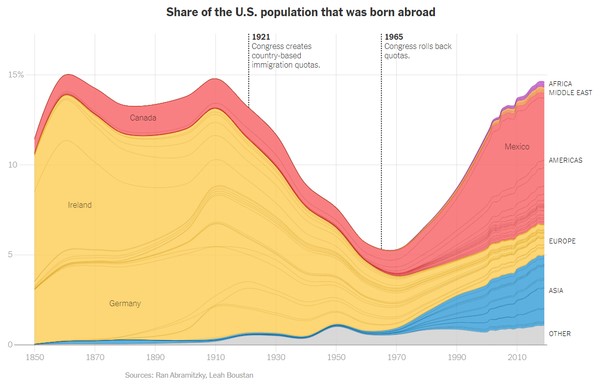
According to the U.S. Department of Homeland Security, the total number of legal immigrants admitted to the U.S. in fiscal year 2022 was 1,051,033. This is down from 1,210,069 in fiscal year 2021 but still represents a significant number of people coming to the U.S. each year. The number of detentions of migrants at the U.S.-Mexico border also remains near record highs.
Aging U.S. Population
The U.S. population is aging, and the birth rate is declining. The number of non-Hispanic White Americans decreased in real numbers for the first time in U.S. history from 2010 to 2020. The reason for this is simple. The non-Hispanic White population in the U.S. is, on average, 44.5 years old, and they are not having enough children to offset natural decline. The average age of newly arrived legal and undocumented immigrants is approximately 31 years old, and they are more likely to have children. Without immigration and the U.S.-born children of immigrants, the population of the United States would be shrinking.
Benefits of Immigration for the Economy
A study by the National Academies of Sciences, Engineering, and Medicine found that immigrants positively impact the U.S. economy. Immigrants are motivated to be self-sufficient and often come to the U.S. for job opportunities, filling gaps in the labor market, especially in sectors that face labor shortages.
Immigrants also have a history of contributing to American entrepreneurship. They are more likely to start businesses, creating jobs and stimulating economic development. High-profile companies like Google, Apple, and Tesla were founded by immigrants or the children of immigrants, showcasing the innovation and drive that immigrants can bring to the American economy.
Public Services
Immigrants, whether documented or undocumented, pay taxes in various forms, including income, property, and sales taxes. These tax contributions bolster government revenue, helping to fund essential public services, such as education, healthcare, and infrastructure. The overall youthfulness of immigrants also decreases their healthcare costs. Public services used by recently arrived immigrants are paid for by the tax contributions of working immigrants and second-generation immigrants, who are among the strongest fiscal and economic contributors in the U.S. Furthermore, studies have shown that immigrants use public services at lower rates than native-born citizens.
While Baby Boomers and the Silent Generation are the least likely to support immigration, they have immigrants to thank for maintaining the Social Security and Medicare trust funds with their payroll taxes.
Culture & Innovation
American culture is immigrant culture. Everything from apple pie and coffee to hot dogs and beer was brought to the U.S. by immigrants. In addition to their culinary contributions, immigrants have profoundly influenced Hollywood, music and the fine arts. This enriched American culture stimulates innovation. A study found that “technology areas (in the U.S.) with higher levels of foreign-born expertise experienced much faster patent growth between 1940 and 2000, in terms of both quality and quantity, than otherwise equivalent technology areas.” The space program (German rocket scientists), the internet (Nigerian refugee Philip Emeagwali, who created a formula that allowed a large number of computers to communicate at once) and a myriad of innovations in other industries were made possible by immigrants.
Conclusion
The U.S. has successfully integrated immigrants into society since its founding, despite the objections of isolationists. Over time, immigrants and their descendants have become integral to the American economy by boosting the labor force, starting businesses, paying taxes and raising families. Evidence suggests that a more welcoming and inclusive approach to immigration can be a powerful force for progress and prosperity.
In addition to the economic and demographic benefits, immigration makes the U.S. qualitatively and quantitatively a better, more vibrant, and dynamic place to live, with new ideas, perspectives, and traditions enriching our culture.
we demistify diverse communities through research technology
Legal
How Fintech is Changing the Way Gen Z Manages Money
Americans are feeling the pinch in their wallets, with fears of a government shutdown looming and prices for everyday goods and services rising. Consumers have been on an economic roller coaster for a few years due to COVID-19, which left millions jobless, and George Floyd's murder, which sparked national protests for social justice. These events have caused a ripple effect throughout the economy, leaving many people struggling to make ends meet.
During the COVID-19 pandemic, many consumers went from overspending to spending far less as household incomes fluctuated. Those who could afford to spend increased their e-commerce purchases and invested in new financial instruments like cryptocurrencies. However, with the continuing economic uncertainty, consumers are generally being more cautious with their spending.
Generationally, Gen Z consumers aged 16 to 25 have proven resourceful when it comes to personal finance, particularly “Zennials” (also known as “Zillennials”), older Gen Z and younger Millennial consumers on the fringes of their cohorts. But unlike Millennials, who as a generation are struggling to catch up to where they should be from a savings perspective due to factors like student loan debt and pandemic losses, have struggled to plan. But their younger siblings, Gen Z, have watched and learned, leaning into advice from family and friends on what to invest in and leveraging fintech tools to manage their money.
Fintech is addressing the gaps in financial planning by meeting consumers where they are – online. Thus, the rise of fintech apps enabling consumers to forgo traditional banking models and embrace digital tools to handle money matters. This has become particularly important to underserved consumers who experience banking differently.
Younger generations are open to using AI-based tools for money management, but they still value human input from parents and financial advisors.

In this episode of The New Mainstream podcast, Lilah Raynor, CEO of Logica Research, explores the money management habits of Gen Z and Millennials and sheds light on AI's impact on financial services.